 Up to OJB's Objects List Return to Previous Page M6
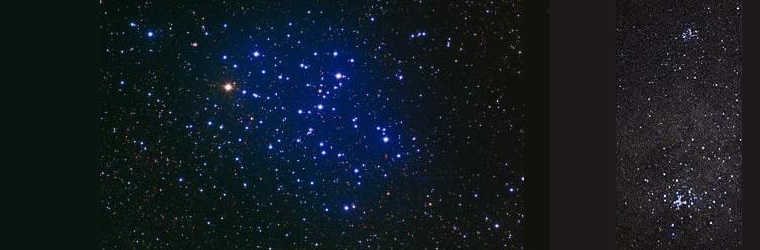
Here's some basic information about M6. It's an open cluster (type e) in Scorpius, also known as NGC 6405 or the Butterfly Cluster. The distance is 2000 light years. The position is at right ascension 17:40.1, declination -32:13. Magnitude is 5.3, diameter 25 arc minutes, true size 20 light years in diameter. Like other open clusters this is quite a young object, just 51 million years old. This cluster contains about 80 stars, the brightest is a distinctive orange giant (open clusters generally consist or young blue stars, in this case 50-100 million years old). The location is easy in the tail of the constellation Scorpius. Close by is another, bigger cluster, M7. These objects are best observed with low magnification telescopes or binoculars. Its unclear who discovered this object but the fact it is a cluster has been known for hundreds of years. The photo on the left is by a professional observatory. On the right is a simple photo I took with a 35mm camera using 800 asa print film mounted piggy-back on a small telescope. The smaller cluster at top is M6 and M7 is the larger cluster at the bottom. 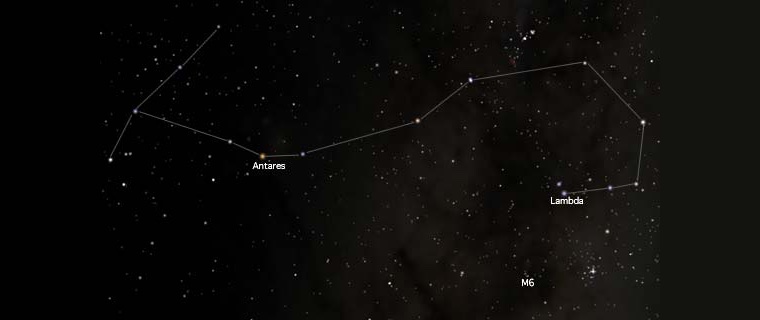 To find M6 you need find the constellation Scorpius. This should be easy because it is one of the largest and brightest in the sky. The brightest star in Scorpius is the red supergiant Antares (apparent magnitude 1.03, the 15th brightest star in the sky). Follow the shape of Scorpius around to the bright stars in the "sting". The shape should be like a large question mark. Find the star Lambda Scorpii (magnitude 1.59, true brightness 57000 Suns). Parallel to this star and the previous one in the Scorpion's tail (Kappa) you should see two clusters. M7 is the more conspicuous one and M6 is the smaller one near the tip of the tail.
| ||||||||||||||||||||||||||||||||||
 OBJECT PAGE