 Up to OJB's Objects List Return to Previous Page M1
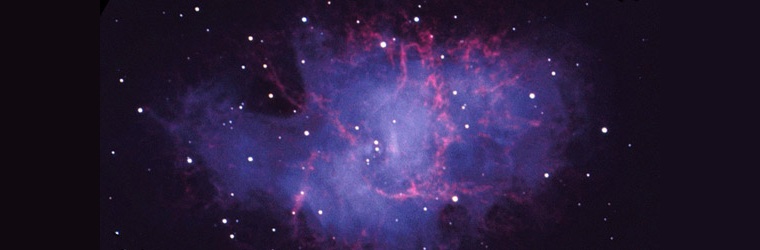
Basic information about M1: a gaseous nebula (supernova remnant) in the constellation Taurus, right ascension 05:34.5, declination +22:01, distance 6200 light years, magnitude 8.4, apparent size 6x4 arc minutes (and expanding at a rate of 0.2 seconds of arc per year), it is also know as NGC1952 and the Crab Nebula. M1 was discovered in 1731 by a British amateur astronomer, John Bevis and is the most well known nebula formed from a supernova explosion. Messier re-discovered the object in 1758 when he was looking for Halley's Comet, and this lead to him creating the Messier catalog. The Chinese observed a supernova (of magnitude -6, visible in daylight for 23 days) in 1054 of the star now known as CM Tauri. The result of this is now visible as M1. In 1968 a pulsar was discovered at the center of M1, this is a neutron star rotating 30 times per second. The energy from this collapsed star illuminates the nebula. The blue lines are caused by strongly polarised synchrotron radiation and the pink areas are conventional emission radiation. In small telescopes this is not a spectacular object, but because it is such a well known nebula (both because it is a thoroughly studied scientific object as well as a popular candidate for "pretty pictures" in astronomy magazines and books) it is worth observing. Because M1 is 22° north it is not ideal for southern observers but is still easy to find and observe under good conditions.  Above, I have attempted to show what the nebula looks like with varying size telescopes. First is the view in a small telescope - just a fuzzy, oval "blob". Next, a larger telescope shows some signs of structure - more than just a blur. Finally a larger telescope (around 14 inches, or more) shows much more of the detailed structure we see in photographs. Binoculars will show M1 as a small, shapeless patch. Small telescopes of 13 to 20 cm start to show some structure and bigger 'scopes of 30 to 36 cm begin to show some of the shape we see in the object from photographs taken from professional observatories (like the one above). 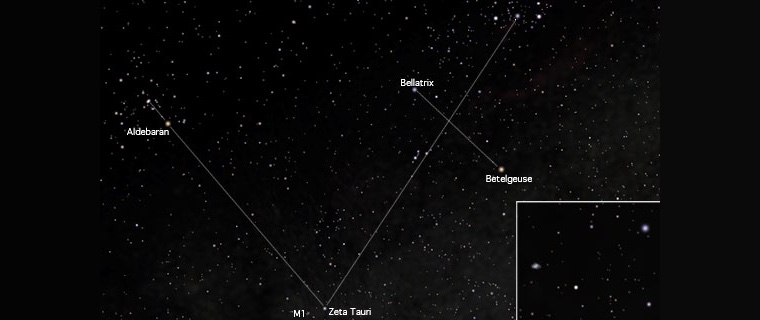 To find M1 you need to locate Zeta Tauri first. Find this start by using the two bring northern stars in Orion, Bellatrix (magnitude 1.6) and Betelgeuse (magnitude 0.43, a red supergiant with real magnitude 60,000 Suns and diameter 670 times greater than the Sun!). Also locate the orange star Aldebaran (magnitude 0.84). Imagine the lines shown in the chart above and find Zeta where they cross. Now use the smaller chart at the bottom-right above and locate M1 using this. The bright star at the top-right of the small chart is Zeta and the fuzzy patch is M1. There's a quite distinct distorted square shape of stars which are useful to find the nebula from. Note: these charts are drawn for Southern hemisphere observers, you will need to re-orient them if you live in the northern hemisphere.
| ||||||||||||||||||||||||||||||||||
 OBJECT PAGE