Entry 2133, on 2021-06-16 at 20:23:02 (Rating 1, Computers)
I thought I might take a brief break from my usual vitriolic political commentary and make a post on a more geeky subject: Apple's future path in terms of its Mac computer hardware.
The main reason I am doing this is the fact that I recently set up one of the new "colourful" iMacs that Apple released a few weeks back. I also use many other Apple products - some of them recent and some quite old - so I think I have a reasonable background for this commentary.
The biggest news in the Apple world recently has been the start of yet another major architecture transition for the Mac platform.
The first Mac, released in 1984, used a CPU (central processor unit, which is the "brains" of the computer) made by Motorola: the 68000. This was a more advanced processor than what PCs were using at the time (the Intel 8086) and Apple branded the new machines as "32 bit super-micros" (or something similar). Since then the 68000 was upgraded to the 68020, 68030, and 68040, but eventually the performance of these reached a point where it wasn't progressing as much as Apple wanted.
So they switched to the PowerPC platform. These were also superior to the CPUs being used by PCs at the time, but the consortium responsible for the PowerPC platform (Apple, Motorola, IBM) just ran out of enthusiasm and the last PowerPCs Apple used were very powerful but also generated a lot of heat, making them unsuitable for use in laptops which Apple (rightly) saw as the future of computers.
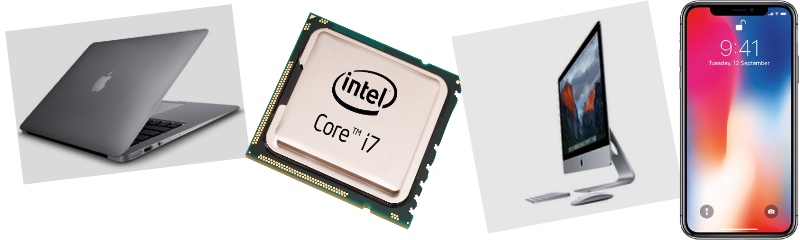
So they took the easy path and started using the same Intel processors that PCs were already using. This meant that one (at least theoretical) advantage of Macs was gone because they could no longer claim to be using a superior CPU, but it did make running Windows software on Macs a lot easier, which was useful to some people.
So, as you might have guessed, Apple are doing it again. Intel seems to have hit the same brick wall as many other manufacturers have in the past. Intel really isn't going anywhere with any speed, so Apple have decided it is time to change again, to a CPU architecture they designed themselves (although some of the underlying design comes from ARM and is used under license).
The new processor is similar to that used in the iPhone and iPad. These devices are far ahead of the opposition in terms of speed, and just as importantly, power use, so Apple do have a good basis to progress the platform using this hardware. Also, it is something they can fully control themselves, instead of depending on the somewhat precarious reliance on Intel's unimpressive future roadmap.
If you are a computer geek you will see the problem here. If you're not, I will briefly explain. Every CPU is like a little brain that takes in instructions and does what is is asked to do. The problem is that every CPU "speaks a different language", so programs (which are just lists of instructions) which work on an Intel CPU will not work on the new Apple silicon.
In the past Apple have provided a "compatibility layer" which is an invisible program which translates the instructions on the fly. So instead of the CPU reading an instruction then executing it, it now reads the instruction intended for the old CPU, translates it into one or more instructions which are the equivalent on the new CPU, then executes them. This worked well for the previous processor transitions, and they seem to have done a good job again this time.
Obviously this translation process does reduce the speed the program can run at, but it is remarkable how fast it actually is. Many people report old Intel programs running faster in the translator (known as Rosetta 2) on Apple silicon than they did directly on the Intel processors (with no need for translation) on older computers, just because the new processors are so fast.
That has been my experience with the several new Apple silicon laptops and the one new iMac I have set up. They really are fast (especially when considering they are all entry level, consumer machines), and the power use is so low that the laptop batteries last a lot longer and they generate less heat as a result. In fact, some of the basic models don't even have cooling fans.
As well as the speed and efficiency, the new processors offer another advantage: they can run programs designed for the iPad much more easily. Maybe the biggest deficiency of the Mac currently is lack of games, but the iPad has plenty. Note that mobile gaming is actually bigger than both the console and PC game markets, and the gaming market overall is far bigger than either movies or music, so gaming does matter.
Of course, it's not all good news. Now that Apple doesn't use the main architecture used by PCs (Intel and clones), running PC programs will be a lot harder. At this point it is unclear how successful PC emulation might be on the new machines. This might be a lesser problem than many would think. For example, I have a Windows virtual machine on my older (Intel) Apple laptop, but I can't remember the last time I used it. Still, it is an issue worth considering.
There are various rumours circulating now that Apple might introduce pro level processors in the near future which might feature a lot of cores. Again for non experts: a core is like a single processor inside a chip, and almost all CPUs now contain more than one. Each core can do some work, so a 2 core processor is (roughly speaking) twice as fast as a single core - if the programs are written to take advantage of them.
Currently, most processors have 4 or 8 cores, but rumours suggest Apple might give us a lot more than that in future; maybe over 100 in total. Also, Apple build different types of cores into their processors (or more accurately systems on a chip - SOCs). So they have high performance cores for speed, high efficiency cores for lighter tasks which need less power and won't drain the battery, specialised cores for signal processing, and graphics cores.
There seems to be a lot of potential here for building really high performance machines which are still relatively light on power use. The SOCs are also a lot smaller, and the whole board in the new iMac is about a tenth the size of the previous model, so the computers can be smaller (check the thickness of the new iMac: about 1 cm). Also, specialised processors allow encryption, security, location awareness, and other functions to be easily and efficiently implemented. Finally, because of fabrication techniques, and in-house design, the new hardware should also be cheaper!
I do have to say though, that the current processors really are intended for use in consumer level devices, so the successful transition to pro level performance is not guaranteed, although most people seem to be optimistic.
So that's the big news from the Apple world. Do many people care about this geeky technical stuff? Well, probably not. But do they care about getting a cheaper, lighter, smaller, quieter, cooler laptop, which is also faster than what they had in the past while having "all day" battery life? Probably yes!
There are no comments for this entry.
You can leave comments about this using this form.
Enter name, email (optional), enter number, comment, click Add. You can leave the name blank if you want to remain anonymous. Enter your email address to receive notifications of replies. Comment should appear immediately (authorisation is inactive).
 BLOG PAGE